Delivering excellent educational and research experiences requires continuous monitoring to drive improvements. The Elson S. Floyd College of Medicine fosters a culture of excellence and accountability by systematically monitoring, evaluating, and enhancing the quality of our medical education and research programs. We are committed to using data-informed strategies and collaborative efforts to ensure ongoing improvement, maintain accreditation standards, and achieve the highest levels of educational and research quality for our students, faculty, and the communities we serve.
Our Continuous Quality Improvement (CQI) process provides a deliberate, reliable framework for promoting quality improvement, evaluating operational effectiveness, identifying measurable improvements, implementing improvement action plans, monitoring changes for effectiveness, and ensuring best practices are replicated.
Committee
Our CQI committee supports CQI activities within the medical education and research programs and ensures monitoring of and compliance with each LCME standard. The committee comprises faculty and staff from each operational area based on their expertise, knowledge, and insight into the medical education program. Additionally, the committee includes personnel at the vice dean, associate dean, and director levels to provide guidance and leadership, maintain monitoring of program quality, and facilitate the management of CQI activities. The committee acts in an advisory and collaborative role with the Dean’s Cabinet, standing committees, and administration on all CQI aspects of medical education and research.
Framework
Our CQI framework provides a structured, systematic approach to ensure the ongoing improvement of educational and research quality and compliance with accreditation requirements. The main components of our CQI framework are environmental scan, data collection and analysis, strategic planning, action plans, governance, feedback, monitoring and review, and outcomes and reporting.
CQI Cycle
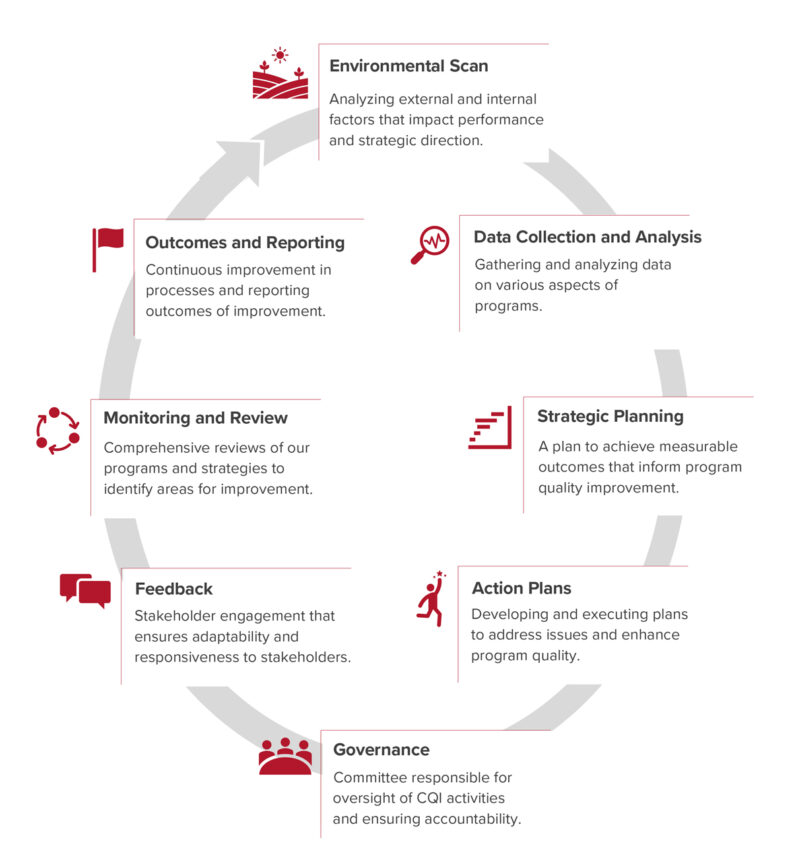
We systematically assess internal and external factors that influence our performance and strategic direction. A SWOT analysis of the college’s strengths, weaknesses, opportunities, and threats supports our decision-making and planning processes and identification of improvement opportunities.
We gather quantitative and qualitative information from various sources (e.g., general surveys, course evaluations, assessments, key process indicators) to evaluate performance, expose trends, discover opportunities for improvement, and develop our strategic plan for achieving long-term quality enhancements.
Our strategic planning process involves setting clear, long-term goals and objectives with measurable outcomes to identify priority areas for improvement, align CQI initiatives with our mission, and establish a roadmap for achieving sustainable quality improvements.
We use comprehensive action plans to implement targeted improvements. These plans outline specific interventions to address problem areas and achieve improvement opportunities. Action plans establish clear objectives, timelines, and accountability, ensuring that all stakeholders are aligned and engaged in implementing improvements.
Our college leadership and CQI committee provide oversight of the CQI process. The CQI committee ensures accountability, advises leadership on prioritization of CQI initiatives, and ensures CQI efforts align with the college mission, vision, strategic goals, and accreditation standards.
We collect feedback from our stakeholders, including students, faculty, and staff, to ensure that CQI initiatives are responsive to their needs and inform further improvement opportunities.
We continuously monitor our performance to ensure we are compliant with accreditation standards and evaluate the effectiveness of improvement initiatives. We review operational outcomes to ensure that our interventions are working as intended and that we are able to sustain achieved improvements.
We assess our outcomes to measure the impact of our CQI initiatives on improving key performance areas (e.g., student performance, accreditation compliance). These findings are reported to leadership, stakeholders, and external bodies to support transparency and drive accountability.