
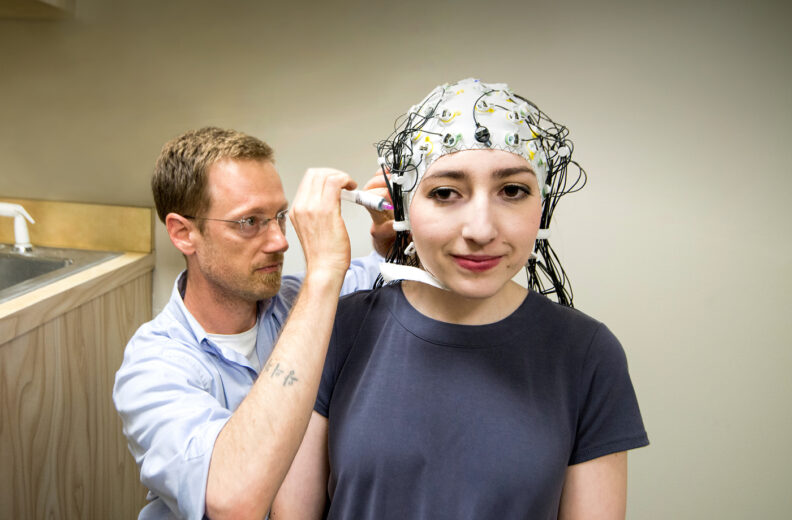
The organ once described as “a jet engine on an ancient horse cart” is a remarkable evolutionary achievement full of surprises. In honor of Brain Awareness Week, here are five fun facts about the cerebrum you may not know.
1. Your Brain Could Power a 25-Watt Light Bulb
The metaphorical light bulb over your head might be closer to the truth than you realize. The brain’s billions of neurons consume 20% of the body’s energy even when at rest, enough to power a small light bulb.
2. The Brain Is Mostly Fat.
Move over neurotransmitters, lipids are the new hot molecule in brain research. The brain is approximately 60% fat, and neuroscientists are just beginning to unravel how fatty acids play a role in brain performance and other critical functions.
“When most people think of molecules in the brain, they think of neurotransmitters,” said WSU Elson S. Floyd College of Medicine molecular neuroscientist Jason Gerstner, PhD. He studies fatty acid binding proteins found in astrocytes, star-shaped brain cells he found play an essential role in sleep regulation. “Lipids are an underappreciated area of study, but modern neuroscience is now considering how cells in the brain operate with lipid signaling.”
3. The Brain Can Store as Much Information as 20,000 iPhones.
Your neural networks may be capable of storing up to 2.5 petabytes of information, equivalent to about 20,000 iPhones with 128 gigabytes of storage. Researchers note that brains are more flexible than computers when it comes to storing memories and other information, but the rough metaphor captures the brain’s extraordinary capacity.
4. Brains Are Unique, like Fingerprints.
Every brain has a unique functional connectivity profile, or pattern of how different areas of the brain connect. These profiles are distinct enough to identify an individual from a group solely using fMRI technology, imaging that measures blood flow to show activity in the brain.
The nonmedical term “neurodiversity” was developed in the 1990s to describe how all brains develop differently. Activist Kassaine Asasumansu later coined “neurodivergent” to describe individuals whose brains work in an unexpected way, and the term has been embraced by people with autism spectrum disorder, ADHD, and other conditions.
5. Human Brains Have Shrunk Since the Last Ice Age.
Our brains have decreased in size by about 10% in the last 100,000 years, research shows. Anthropologists debate various possible explanations for this shrinkage, from the invention of language enabling more symbolic and thus efficient thinking to a warming climate making smaller, quickly cooling brains more adaptive. Still, the average adult brain today weighs 3 pounds and more than pulls its weight.