
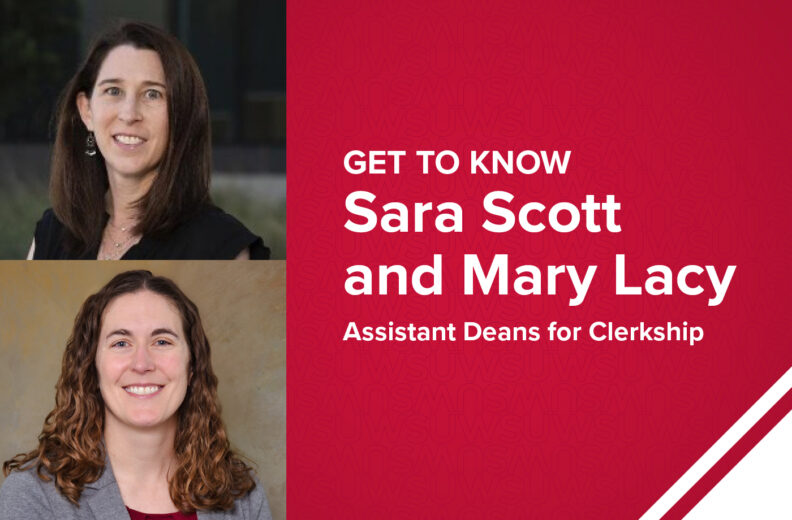
Today’s rapidly evolving health care environment demands agile medical education curricula and assessment to prepare graduates to serve as leaders in patient care. We spoke with two of the minds behind the WSU College of Medicine’s MD programming, Sara Scott, MD, FAAEM, and Mary Lacy, MD, FACP, FHM, to learn more about their approach to curriculum and assessment and priorities for the upcoming year.
With Sandra Smith, MD, now overseeing the program’s curriculum as Associate Dean for Curriculum, Scott has returned to her newly retitled role of Assistant Dean For Clerkships – Curriculum, with Lacy continuing in her role as Assistant Dean for Clerkship – Assessment.
Can you tell me a bit about your educational and professional background? How did you become interested in curriculum and assessment in medical education?
Sara Scott: I became interested in curriculum development during my time as a medical student when I was exposed to high-fidelity simulation, which sparked my interest in interactive medical education. This interest deepened throughout my residency, where I saw firsthand the impact of well-designed curricula on learners’ development. After completing my residency in emergency medicine, I pursued an academic fellowship, which led me to a career in academic emergency medicine, where I had the opportunity to work as faculty in several residency programs and, more recently, as a clerkship director. These experiences allowed me to engage directly with curriculum development, furthering my commitment to improving and shaping the learning experiences of future physicians.
Mary Lacy: I am originally from Kentucky and went to medical school at the University of Louisville. I trained in internal medicine at the University of Washington and met my partner in Seattle. That is how I ended up with roots in the Pacific Northwest that brought us back with a growing family and extended family. My interest in medical education started in medical school and grew in residency and during my time as an academic hospitalist at the University of New Mexico. I served as the associate clerkship director of the internal medicine clerkship there and was the director of the sub-internship prior to becoming an associate program director with their residency. In my time working with residents, I helped to improve processes on our competency panel and worked with individual learning plans for our residents. All of those interests made the fit in this role appealing.
What do you find most rewarding about this work?
SS: The most rewarding aspect of this work is the opportunity to shape the learning experiences of future generations of physicians. Knowing that the curriculum and assessments we design directly influence how students will approach patient care is deeply fulfilling. It’s especially gratifying to witness students thrive when they are supported by a curriculum that empowers them to apply their knowledge and clinical skills in meaningful ways, while encouraging them to view assessments through a growth mindset and a competency-based lens.
ML: I love the mission of Washington State University, I love when I get to work with students doing things like academic half day facilitation, and I find it meaningful and important to take something as complex as assessment and make it work as smoothly and transparently as possible.
What is your vision for clerkship curriculum and assessment in the MD program?
SS: My vision for the clerkship curriculum is to work with all our regional collaborators to provide a learning experience that is both comprehensive and adaptable to the ever-evolving needs of healthcare. We aim to develop a curriculum that emphasizes interdisciplinary learning, integrates core competencies with real-world applications, and prioritizes reflective practice and ongoing professional development. Furthermore, I hope the curriculum encompasses critical skills in communication, collaboration, and empathy—fundamental qualities for delivering effective, patient-centered care.
ML: My vision is to continue to work to demystify increase accessibility of assessment for students and faculty. I want our unit to continue our work with a lens around fairness, transparency, and accountability to students and faculty. I would love to increase the connections of our office with frontline preceptors as well.
What are your top priorities for the next academic year?
SS: For the next academic year, my priorities would focus on two main areas: 1) curriculum evaluation and improvement: continuously assessing the effectiveness of the curriculum to ensure that it meets the evolving needs of medical practice and integrates emerging health care trends, such as telemedicine and artificial intelligence use; and 2) faculty development: working on faculty development modules to ensure that faculty have the tools and support they need to effectively implement and assess the curriculum.
ML: With the departure of the Associate Dean of Assessment, Dr. Dawn Cooper, my top priority is stabilization and support of our unit so that we may continue to support students and faculty. Dr. Cooper’s departure will bring challenges, but she helped built an incredible team and we are well suited to do this work. Beyond that, I will be looking for opportunities to streamline our work and balance the co-existing priorities of personalized support and efficient systems practices.
How do you ensure our curriculum and assessment methods remain innovative and prepare graduates to practice in an evolving health care landscape?
SS: To ensure the curriculum remains innovative, I think you need to foster a culture of continuous improvement and collaboration. Regularly soliciting feedback from students, faculty, and practicing clinicians helps identify areas for growth and ensures we stay ahead of trends. Attending national and international medical education conferences and actively participating in several medical education discussion groups provides valuable insights into emerging best practices and global trends, which can further inform our approach.
ML: A lot of this comes down to maintaining relationships with other regional and national institutions whether it be through committee work, attending conferences or simple literature reviews. I am preparing a talk now for internal medicine clerkship assessment and look forward to not only sharing what we are doing, but hearing the successes and challenges of other participating institutions.