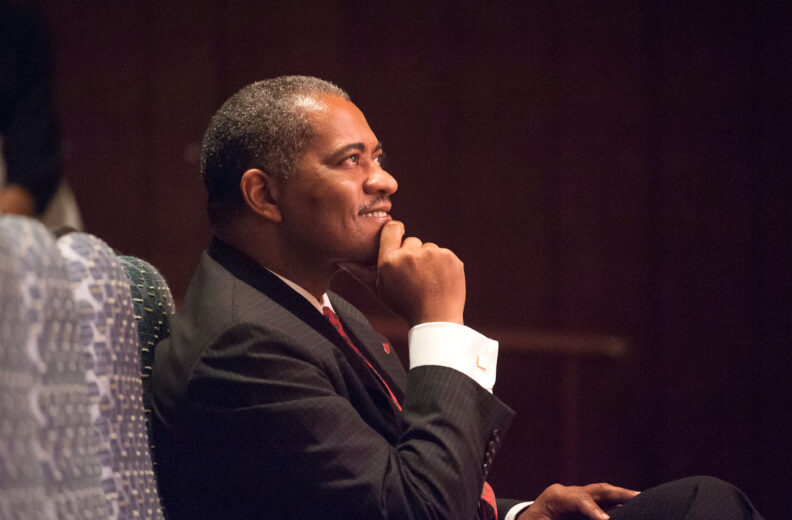
As we celebrate the 10-year anniversary of the Washington State University Elson S. Floyd College of Medicine, we honor the remarkable life and legacy of our namesake, Elson S. Floyd, whose visionary leadership transformed medical education in Washington and laid the foundation for a healthier future for all who call the state home.
Elson S. Floyd, PhD, served as WSU’s 10th president from 2007 to 2015. A nationally respected advocate for accessible, affordable higher education, he was deeply committed to WSU’s land-grant mission. He championed educational and research programs that served the needs of Washington State and its people.
“I have never met such a visionary, effective, passionate professional as Elson Floyd,” WSU Board of Regents member Michael C. Worthy said at the time. “He has the ability somehow to channel vision and passion to execution.”
In 2008, Dr. Floyd outlined his plan for an interprofessional health sciences hub at WSU Spokane that would expand access to medical education and health care in Washington’s rural and underserved communities. Under his leadership, WSU’s health sciences programs, including the Colleges of Nursing and Pharmacy and Pharmaceutical Sciences, were consolidated in Spokane two years later.
Dissatisfied with WSU’s decades-old agreement to train doctors through the University of Washington’s WWAMI program, Dr. Floyd then advocated for the creation of an independent medical school based in Spokane.
“Washington State University has worked to serve the needs of our state, nation, and world for 125 years, and successful development of a medical school is one more way for us to improve the health and well-being of Washingtonians,” he said.
He worked tirelessly to gain community and bipartisan support for the new school, efforts that were rewarded in 2015 when the state legislature amended a nearly century-old law to allow WSU to create its own medical school.
Dr. Floyd didn’t live to see his vision of Coug doctors realized. He died of complications from colon cancer at age 59, just two months after the legislation was signed. Later that year, the WSU Board of Regents recognized his essential contributions to the newly established medical college when they voted to name it in his honor.
In his stead, Dr. Floyd’s widow, Carmento Floyd, attended the 2017 White Coat Ceremony for the college’s first medical students.
“My husband, former president Elson S. Floyd, believed that if greatness could be accomplished, it could be done at Washington State University,” she said at the occasion. “Your journey as the inaugural class of the Elson S. Floyd College of Medicine fulfills his dreams.”
An Unparalleled Education Legacy
As university president, Dr. Floyd’s accomplishments extended beyond the creation of the medical school to encompass milestones in enrollment, research, and the expansion of other academic programs to provide Washington students with a 21st-century education and foster economic development in the region.
Dr. Floyd transformed WSU into a top-tier research university while navigating some of the direst fiscal challenges in the institution’s history, successfully leading the university through a $1 billion capital campaign. Under his leadership, overall student enrollment and research expenditures reached record highs, growth trajectories continued under 11th WSU President Kirk Schultz. The university also established the Edward R. Murrow College of Communication and the Paul G. Allen School for Global Animal Health and expanded its urban campuses across the state during Dr. Floyd’s tenure.
Affectionately known as “E Flo,” a moniker now lent to the College of Medicine’s learning management platform “E Flo MD,” Dr. Floyd was a favorite among WSU students. He often greeted students by name and gave many his personal cell phone number, encouraging them to contact him if they needed anything. A frequent attendee at WSU sports events, he was known to cheer energetically from the student section.
When advocating for the value of higher education to lawmakers, Dr. Floyd often drew on his own background as an example of education’s transformational power. Born in segregated Henderson, North Carolina, to a brick mason and a tobacco factory worker, he was the first in his family to attend high school and later college. He earned a scholarship to the prestigious Darlington School in Georgia, becoming its first African American graduate, and received his doctorate in higher and adult education from the University of North Carolina at Chapel Hill.
Dr. Floyd worked in higher education for his entire career, holding leadership positions at Eastern Washington University, Western Michigan University, and the University of Missouri before returning to Washington to lead WSU.
This story includes contributions from the WSU News Archive.