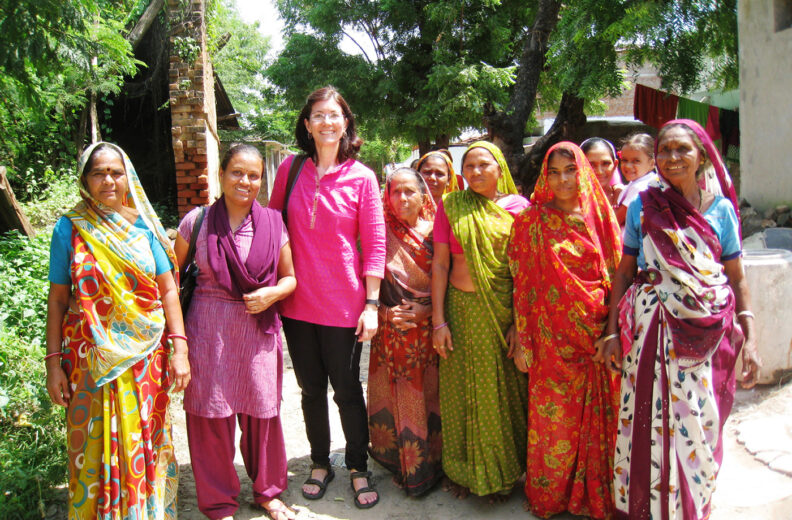
When Jeanna Holtz, Nutrition and Exercise Physiology Alum, updated her estate plans, she found herself returning to the place where her journey began: Washington State University.
“I had WSU in my sights as the possible recipient of a gift,” she recalled. One chat with a fellow Coug, followed by a serendipitous connection with department Chair Glen Duncan, PhD, ACSM-CEP, brought the program into fresh focus.
“Turns out he’s my neighbor, and I could really relate to the vision Glen shared with me for the program,” Holtz said. “We face a long road to reform our health system and build healthier communities. One part of that is educating the public and health providers to use evidence-based nutrition to support better health.”
Her interest in building healthier communities has shaped her life.
Nutrition at the Front Lines of Cancer Research
Holtz left her hometown in Edmonds, Washington, to attend WSU at the age of 17. She was the first of her family to attend college.
“The world was big. I hadn’t been anywhere. I wasn’t surrounded by mentors or prescriptive career pathways,” she said. “I loved school. I loved science. But I didn’t know what I wanted to do.”
What she did have was an interest in food, cooking, and health. Growing up with working parents who owned a small business, Holtz was accustomed to handling meal prep for her family of five. “I began baking bread,” she said. “I loved the chemistry behind it.”
Her interests led her to the Fred Hutchinson Cancer Research Center following her graduation in 1979. There, she began as a cook for bone marrow transplant patients. “We were preparing a la carte food orders under a chemistry hood and following sterile protocols to make eating safer for immune-suppressed patients,” Holtz said.
This work soon led her to coordinate nutrition studies investigating how intravenous nutrition could help patients survive the severe effects of chemotherapy and radiation.
Holtz’s early work at Fred Hutch led her to consider medical school or a graduate degree in biochemistry, but she realized something important: “I saw scientists who were hyper-focused on technical things, like an enzyme reaction. I found I was better suited for a broader scope—and I wanted to do something I could talk to people about.”
In pursuit of this future, Holtz decided to earn an MBA with an emphasis on health care management at Northwestern University. This decision opened a world of opportunities for her.
Health Care Far from Home
Holtz spent several years in healthcare consulting in Chicago after graduate school, learning more about the business of health care. Taking a position with what is now Ernst & Young, she conducted financial feasibility studies and business planning for hospitals and physician groups. Later, she began building and managing emerging health provider networks and managed care models for insurance company Aetna and various partners.
“I saw how health care was delivered. What it cost, how it got paid for, how the pieces connect—and often didn’t,” she said. “It’s like looking under the hood of a car.”
Holtz stayed with Aetna for ten years, relocating to Seattle and working through multiple mergers before another opportunity presented itself: a friend from her Chicago rowing club connected her with global financial services provider Allianz. That connection eventually led her to Allianz headquarters in Munich in 2006, where she joined a small group charged with expanding and improving Allianz health insurance businesses around the world.
“I left Seattle with a one-way ticket in hand,” Holtz recalled fondly.
Over the next six years, Holtz traveled widely, learning about international health financing— from Colombia to Turkey to South Korea.
Her next leap was from the private sector to international development, when she accepted a position in 2008 with the United Nations’ International Labor Association in Geneva. There, she put lessons learned into action to help design and then manage a $34 million Bill and Melinda Gates Foundation grant to evaluate methods to expand insurance for low-income households in developing countries. Returning to the U.S. in 2014, Holtz joined development consulting firm Abt Associates, based in the Washington D.C. area.
There, she worked to strengthen health systems in Africa and Asia. These positions were a crash course in innovative ideas to help people access better health services in diverse, resource-poor settings—and the challenge of implementing those ideas.
“I’ve seen everything go wrong,” Holtz said. “There are great ideas, but they’re really hard to implement on the ground. It’s about constant problem-solving: how to turn ideas into sustained impact.”
A Global Perspective on Nutrition
Holtz’s international work shaped her worldview.
“Once you see starving kids, you don’t forget it,” she said.
She saw the rising burden of chronic diseases, including heart disease and diabetes, co-exist with and compound the impact of largely preventable conditions such as malnutrition, maternal mortality, and communicable diseases such as malaria.
She also saw health systems being designed around what she referred to as “sick care,” where the focus is on costly treatment rather than preventative medicine and wellness. “We have to better equip health workers and communities to support the upstream work, such as education, to promote health and prevention, and also to care for us when we are sick.”
This vision is one reason why the Nutrition and Exercise Physiology program resonates deeply with Holtz.
“Nutrition is a Rubik’s cube: it’s about science, culture, and economics, among other things,” Holtz explained. “I applaud WSU for working to better integrate nutrition into health sciences and recognizing the role it plays in health.”
Giving Back in Support of Healthier Lives and Communities
After seeing the generosity of others across the world, from all walks of life, the question Holtz turned back to herself was “How do I give back?”
She hopes her planned gift to the Nutrition and Exercise Physiology program and its students will accelerate the use of evidence-based nutrition to promote health, particularly in underserved communities.
Her advice to future health care leaders echoes her own path:
“Be open and don’t get hung up on a plan,” she advises. “Opportunities also gifts that come along, and it’s about being ready.”