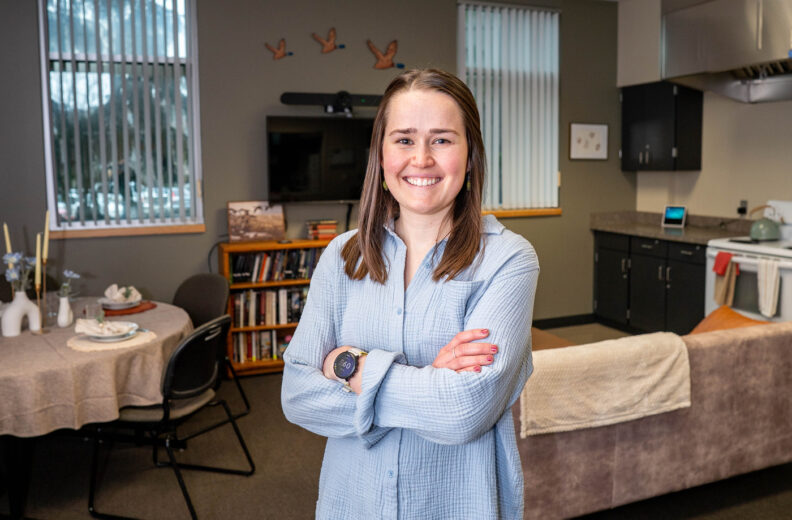
Whether she’s on the road bringing health screenings to rural Washington or advocating for investment in research on the national stage, Hannah Rae Tjelle’s passion for brain health is unmistakable.
That passion recently earned the Department of Speech and Hearing Sciences graduate student national recognition for her work to support people experiencing cognitive decline and promote healthy aging. Tjelle was selected as a finalist in the Alyse Gray Parker Memorial Student Video Challenge hosted by The Science Coalition, an alliance of the country’s leading research institutions.
Tjelle’s video highlights her research with Assistant Professor Amy Kemp, PhD, CCC-SLP, in the Accelerating Research in Cognitive Communication Health (ARCCH) Lab at the WSU Elson S. Floyd College of Medicine. Tjelle studies how to best support adults with mild cognitive impairment (MCI), a state between normal aging and dementia with subtle but measurable changes in cognitive function.
“I was brought to tears multiple times making this video,” Tjelle said. “The video is centered around family and caring for those we love with a spectrum of diverse brains, which is the heart of why I wanted to become a speech-language pathologist.”
Many adults with MCI go on to develop Alzheimer’s disease or related dementias—an urgent economic and public health crisis for an aging population. Tjelle’s mission is to increase awareness about the many ways individuals can reduce their risk of dementia and protect their brain health. Modifiable risk factors include cardiovascular health, social-emotional well-being, nutrition, sleep, and other lifestyle factors.
Her interest in the topic was first sparked by past experience providing respite care for older adults. That interest deepened through her educational and research experiences in WSU’s Master of Science in Speech and Hearing Sciences program, which prepares graduates for careers as speech-language pathologists (SLPs).
“I fell in love with that work, and I chose this degree once I learned I could make a meaningful impact as an SLP and bring dignity and voice to those living with neurodegenerative diseases and their families,” Tjelle said. “The excitement that Dr. Kemp brought to our neurogenic cognitive communication course only grew my interest.”
A clinical experience last year sealed the deal. Tjelle joined Kemp’s BRAIN FIT initiative, which aims to advance the science of cognitive decline through research and outreach. A mobile clinic brought free brain health screenings and education about risk factors to communities across eastern Washington and northern Idaho.
“That experience lit a fire in me,” Tjelle said. “I want to teach everyone about the modifiable risk factors for long term brain health.”
Data from the mobile clinic screenings and regular follow-ups is being collected in a repository, allowing researchers to study cognitive health trajectories over time.
Tjelle is most interested in how to support individuals who have begun to experience cognitive decline but could improve their quality of life and extend their ability to live independently through behavior change. Her thesis research using data from the repository found that adults with MCI made on average fewer changes after visiting the clinic, indicating a need for additional support.
Tjelle’s goal after graduation is to become a go-to resource for individuals experiencing changes in cognitive function and their loved ones. MCI can affect anyone at any point in their lives, not just older adults—traumatic brain injuries, stroke, infection, neurodegenerative diseases, chemotherapy, and other medications can cause MCI, Tjelle noted.
“Anyone we care about can have MCI,” she said. “Whether someone is recovering from an illness or coming to terms with a new diagnosis, an SLP can support them and their families along the way and offer practical, immediate, and effective tools to support autonomy and create a flourishing life wherever they’re at.”