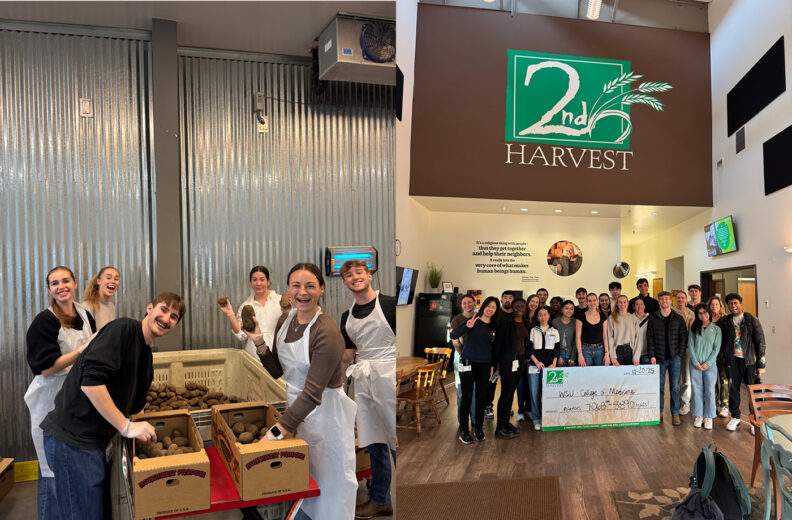
Clinical Campus Weeks aren’t just a chance for medical students at the WSU Elson S. Floyd College of Medicine to get to know the community where they’ll do their clinical training—they’re a chance for students to roll up their sleeves and give back.
Last month, the Tri-Cities cohort of the Class of 2029 spent the afternoon volunteering at Second Harvest during their first day visiting the area. Together, the students packed 7,068 pounds of potatoes, equivalent to 5,890 meals.
“Since the students are learning about weight, malnutrition, and food-insecurity, volunteering at Second Harvest was a perfect fit,” said Vice Chair for Surgery Anjali Kumar, MD, MPH, FACS, FASCRS, who practices in Tri-Cities.
The event is the brainchild of Tri-Cities Regional Dean Farion Williams, MD, who has long emphasized the value of community service. Students assigned to the Tri-Cities learning community have been volunteering in at the food sort event since 2018.
This year, students, staff members Phil Boal and Shannon Horne, and faculty members Dr. Kumar and Vice Chair for Emergency Medicine Kevin Hodges, MD, FACEP, joined the effort to sort, pack, and box potatoes, all while sharing laughs and getting to know one another outside the classroom.
Teams staffed various stations, from box-building to quality control to potato sorting. The fastest packing team managed to fill a full box in under 90 seconds.
First-year medical student David Huang shared that it was “the most fun workout we’ve had all week!”
One student discovered a potato shaped like a heart, while another found one that looked like a duck. The entire operation felt like a well-oiled machine by the end, participants reported.
“It was a great way to give back, connect with peers, and make a tangible impact in the community we serve,” Dr. Kumar said, noting that the southeast region of the state produces much of Washington’s food and many of her patients are farm workers.