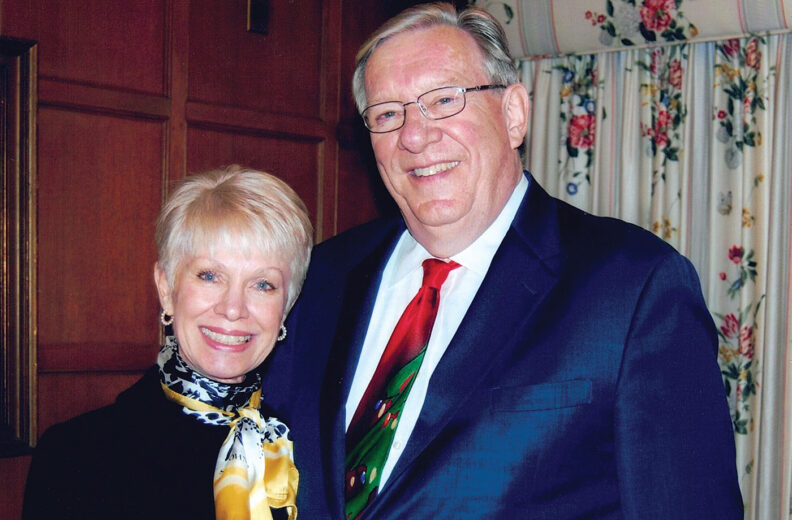
For Joel DeLisa, MD, a proud Washington State University alumni and international leader in Physical Medicine and Rehabilitation (PM&R), medicine was a career “that never should have happened.”
He grew up and graduated from high school with just 60 students in Buckley, Washington. A small, rural town near Mt. Rainier, Buckley had only one primary care physician, who devoted his life to serving his community.
DeLisa had a strong appreciation for hard work at an early age. His grandparents had immigrated through Ellis Island before going on to work in coal mines in Carbonado and Wilkerson, Washington. Having lost his father to cancer at the early age of 42, he and his two younger siblings were raised by his mother.
“She strongly felt our future depended on education,” DeLisa recalled.
This belief became his compass, and DeLisa began working at age 11 to help fund his college education. When WSU awarded him a scholarship, it was the opportunity he needed to chase his future.
“That made all the difference,” DeLisa said. “To show you how practical I was, I took 18.5 credit hours that first semester, when the average was 15.5.”
At WSU, DeLisa found himself drawn to pre-medicine and immersed himself in study, often walking back from the library to Waller Hall late at night, determined to finish his degree in four years. He began working as a chemisty lab instructor in his third year and was able to graduate with no debt. These early experiences grounded DeLisa’s enduring commitment to furthering access and education for future physicians.
During his four years of medical school at the University of Washington, DeLisa met his wife-to-be, Janet Hopper DeLisa, who was working at Swedish Hospital Medical Center. Janet studied microbiology and public health under Elizabeth Hall, PhD.
After medical school, DeLisa went on to complete an internship at Arizona’s St. Joseph’s Hospital. He was then drafted in the U.S. Army on the heels of the Vietnam War—an experience that delayed his residency for two years but would ultimately evolve his career and view of health care. His additional training in preventative medicine changed his mindset from patient-level treatment to the bigger picture of creating systems to help many people rather than one at a time.
After his two-year stint in the military, he completed a three-year residency in Physical Medicine and Rehabilitation at the University of Washington, where he honed his skillset. He continued to work at UW’s Department of PM&R for 12 years alongside its founding chair, Justus Lehmann, MD.
He then moved simultaneously to several positions in New Jersey health care, where he was positioned at the intersection of health care, research, and policy, serving as the medical director of the Kessler Institute for Rehabilitation, the founding director of the Kessler Foundation’s Research Division, and the chair of Physical Medicine and Rehabilitation at Rutgers New Jersey Medical School. Throughout these seminal roles, his leadership transformed both institutions and medical education. DeLisa feels his greatest contribution to residents and physicians in rehabilitation medicine was the publication of the textbook, DeLisa’s Physical Medicine and Rehabilitation: Principles and Practices, first published in 1988 and now in its seventh edition. It remains a foundational resource in the field.
A member of the National Academy of Medicine and the Ellis Island Honor Society, DeLisa remained committed to helping other people who came from rural communities have access to medical school. When WSU launched its medical school, he and Janet saw a chance to give back in a transformative way. In partnership with Providence St. Luke’s Rehabilitation Medical Center, they established the DeLisa Lectureship and Continuing Education Fund in Physical Medicine and Rehabilitation —the college’s first lectureship.
The lectureship reflects a life guided by a belief in the importance of helping others succeed. From training medical students and residents to advocating for greater access to care, DeLisa’s career has been defined by purpose and service.
“He trained everybody to succeed, whether one chose to serve clinically or to enter academic medicine,” reflected Janet. “He treated them like they were family.”
DeLisa retired at 70 and now lives in Santa Fe, New Mexico. The DeLisa’s are enjoying traveling the world together and seeking to visit each continent. Though they are no longer working in the medical field, they continue to shape medicine through this new legacy.
“I never imagined something like this would bear my name, but I wanted other people who came from an underserved background to go into medicine,” DeLisa said. “I would hope for them to go back to their communities to serve.”