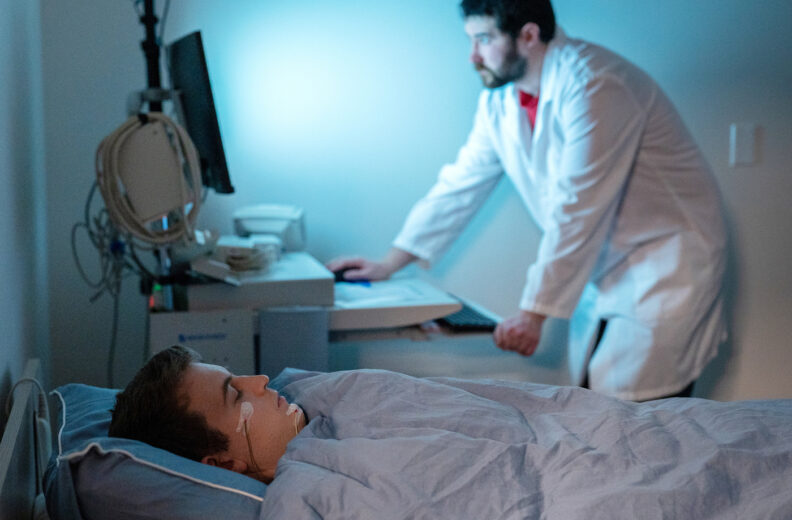
WSU Elson S. Floyd College of Medicine researchers believe sleep may be the unsung hero of cancer prevention and treatment.
While we’ve all heard common pieces of advice to reduce our risk of developing cancer—wear sunscreen, avoid tobacco, and eat a balanced diet – the role of sleep is rarely discussed.
At the Sleep and Performance Research Center, researchers aim to better understand the role of sleep deprivation and circadian rhythm disruption in cancer, work they hope will translate into healthier populations and better outcomes for cancer patients.
Chronotherapy and the Damaging Effect of Sleep Deprivation on Cancer Risk
A growing body of research shows that different aspects of sleep, including timing and quality, can affect cancer risk as well as response to treatment.
Supported by the Henning Cancer gift to the college, circadian biologist Yool Lee, PhD, and his team study the role of circadian rhythms in cancer treatment and progression in osteosarcoma and glioblastoma, or bone and brain cancer.
A circadian rhythm is the body’s natural cycle of sleeping, waking, and eating, cued by environmental factors such as light and dark and regulated by the body’s internal circadian clock. Almost all cells in the body have their own circadian clocks.
Because cells’ biological processes vary over 24 hours, the time of day medications are taken can affect how well they work. That’s why doctors recommend taking some medications at a certain time of day. Optimizing the effect of treatment through timing is referred to as chronotherapy.
Most cancer treatments are given without consideration to the time of day. However, Lee said that’s a mistake.
He recently tested how effective different anti-cancer drugs were at shrinking osteosarcoma tumors in the lab based on the time of day they were administered and found that timing matters.
“Osteosarcoma cells show different responses to treatment depending on what time they’re treated,” Lee said. “The best time of day depends on the drug.”
“Clock genes” that regulate circadian rhythms in cells could be another target for cancer treatments. Tumors have two kinds of cells: cancer stem cells at the core and regular cancer cells on the periphery or the outside of the tumor. Most chemotherapies are better at killing cells in the periphery than in the core, and tumors can regrow from the core after treatment, causing a relapse.
Lee found in lab testing that targeting clock gene molecules made treatments more effective at killing cancer cells in the core, which could reduce the risk of relapse.
Another focus of Lee’s research is investigating how sleep deprivation and disruption to circadian rhythms affect tumor development. Past research has shown that circadian rhythm disruption, like chronic jet lag, can have profoundly negative consequences for people’s health. Building on this, Lee’s prior research uncovered how chronic circadian disturbances speed up cancer growth at the molecular and cellular levels.
Now, Lee is exploring whether circadian disruption also increases people’s risk of cancer by affecting the body’s immune system.
Even young, healthy people’s bodies produce thousands of cancer cells every day. Only the immune system prevents them from becoming a problem: cytotoxic immune cells, the foot soldiers of the immune system, find and destroy cancer cells and other pathogens.
But even a single night of sleep deprivation suppresses these immune cells and interferes with their cancer-killing capabilities, Lee found through a bioinformatic analysis of brain cancer models like glioma. This creates a “pro-tumor environment” that increases the chances that cancer cells will escape detection and take hold in the body, causing disease.
Understanding and Addressing Increased Cancer Risk from Shift Work
Neuroscientist and sleep researcher Brieann Satterfield, PhD, is looking at the effects of sleep deprivation and circadian rhythm disruption on cancer in one underserved population in particular: shift workers.
15% of the U.S. population does shift work, or work done outside of a typical 9 a.m. to 5 p.m. schedule, such as night shifts. Shift work is associated with a range of poor health outcomes, including a greater risk of heart disease, obesity, diabetes, and depression.
“This population is substantially underserved with regard to health research and clinical practices,” Satterfield said. “They’re kind of ignored. They’re just this workforce that does everything in the background that most of us don’t even interact with, but they suffer a much higher health burden than the rest of us.”
Shift work has also been classified by the World Health Organization as a probable human carcinogen or likely cause of cancer since 2007.
Like Lee, Satterfield and colleagues at the Sleep and Performance Research Center have found that even a few nights of sleep displacement can have striking and negative consequences for cancer risk.
One experiment at the center’s Human Sleep and Cognition Lab explored the effects of circadian rhythm disruption at the cellular level. Volunteers who had never worked night shifts were brought to the lab for three days and assigned to either work during the day as usual or to work during the night, disrupting their circadian rhythms. The researchers then collected blood samples to analyze the differences between the two groups.
“We found increased DNA damage in individuals that were on the night shift schedule,” Satterfield said. This also included a change in circadian rhythms of DNA repair genes, which help fix everyday damage to DNA that can cause cancer. “It’s pretty amazing to me that we had such profound effects after three days.”
While study volunteers returned to their normal schedules and their bodies repaired the damage, these findings are especially concerning for people who have done shift work for years and accumulate damage over time, Satterfield said.
One of her current projects, funded by the state’s Andy Hill Cancer Research Endowment Fund and the Health Sciences and Services Authority of Spokane County, is studying this damage in people who have worked night shifts in “the real world” outside of the lab for at least five years.
Once research has uncovered the biological mechanisms behind why people who do shift work have poorer health outcomes, the next goal is identifying preventative measures or therapies that reduce shift work health risks, Satterfield said.
While researchers can’t solve the structural problems of a 24/7 economy that creates demand for shift work, they can identify measures that help reduce damaging molecular and cellular changes from shift work, such as eating meals at certain times.
Cancers are complex diseases without any one cause, but WSU researchers emphasize the importance of prevention. Getting adequate sleep, particularly aligned with natural circadian rhythms, is just one of many lifestyle factors within people’s control, and a simple way to reduce your cancer risk.