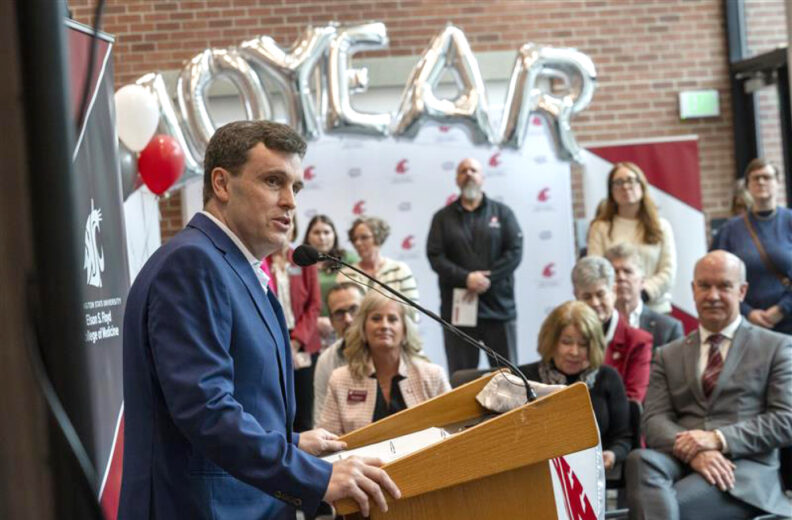
SPOKANE, Wash.—Current and former members of the Elson S. Floyd College of Medicine community gathered from across the state and country last week for a heartfelt celebration of the college’s achievements and ongoing commitment to improving health care access in Washington and beyond.
Held on April 1, the day the state legislature authorized WSU to create a medical school in 2015, the event was one of the largest in the college’s history. More than 150 attendees—including university leaders, legislators, faculty, staff, and community partners—gathered under crimson and silver balloons to toast college milestones and acknowledge the people and partnerships that made them possible.
One special attendee was Carmento Floyd, widow of college namesake and visionary Elson S. Floyd. She shared her pride in the college community and our dedication to making Dr. Floyd’s vision of a medical school at WSU a reality.
“Elson saw greatness in Washington State University, and he was joined with many other like-minded individuals who saw his vision and the need for the medical college,” she said in a speech. “Without you, there would be no Elson S. Floyd legacy.”
Other speakers included WSU College of Medicine Dean James Record, WSU Spokane Chancellor and Health Sciences Executive Vice President Daryll DeWald, Spokane Mayor and former WSU Spokane Chancellor Lisa Brown, WSU Regent Marty Dickinson, and Spokane Tribal Business Council Secretary Monica Tonasket.
Cassidy MacArthur, a graduate of the MD Class of 2022, spoke about how losing her father due to a lack of timely medical care spurred her to become a doctor. Once she completes her training in physical medicine and rehabilitation, she will become the first fellowship-trained spinal cord injury specialist in eastern Washington.
“Spokane is my home,” she said. “The people here are my people, and I will dedicate my career to serving them, advocating for them, and making sure that no one is left behind or forgotten when it comes to health care.”