The Washington State University Elson S. Floyd College of Medicine is celebrating 10 years of training homegrown health care providers to improve access to care in Washington communities. However, the story of the college began long before WSU broke ties with WWAMI to create an independent medical school.
Until 2015, a nearly century-old state law gave the University of Washington the exclusive right to confer medical degrees in Washington state. For decades, WSU trained medical students through WWAMI, a UW medical education program that includes agreements with universities in Washington, Wyoming, Alaska, Montana, and Idaho, giving the program its name.
WSU’s discontent with WWAMI boiled over into public view in the early 2010s, when university leadership argued UW wasn’t providing enough seats for medical education in eastern Washington despite a critical need for more doctors in the region. At the time, UW admitted 120 medical students per year and turned away hundreds more, with just 20 seats allocated to a pilot program to train more medical students at WSU Spokane.
“For probably 30 years there’ve been a lot of people working in Eastern Washington to try to bring more medical education to this side of the state, and we need it,” the chief medical officer of the Providence health care system in Spokane told The Spokesman-Review in 2014.
When the pilot program saw disappointing enrollment, WSU officials faulted UW’s lackluster recruitment effort and began to float the idea of an independent medical school in Spokane.
“We want UW as a partner with us, but if they won’t, this is important enough to us that we’re going to have to plow our own way,” then-WSU President Elson S. Floyd told The Spokesman-Review in 2013.
UW leadership at the time wasn’t convinced.
“Good luck. That’s a multimillion-dollar task,” then-UW President Michael Young said, according to the newspaper, adding that Floyd’s comments reflected “not understanding how a medical school is run.”
WSU moved quickly to prove Young wrong. Having already invested $80 million in the new Pharmaceutical and Biomedical Sciences Building at the Spokane campus, in 2014 the WSU Board of Regents concluded WSU was well-positioned to create its own medical school. The universities announced they were mutually dissolving their WWAMI agreement.
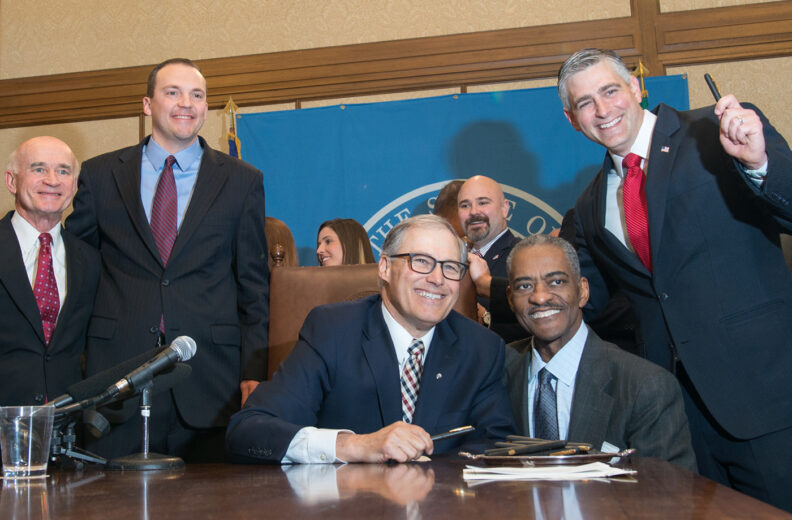
WSU leadership then turned their focus on the next obstacle: the 1917 state law that prevented the university from issuing medical degrees. Extensive advocacy by Floyd and other officials bore fruit when then-Governor Jay Inslee signed into law a bipartisan bill that gave WSU the authority to create an independently accredited medical school in April 2015.
WSU’s College of Medical Sciences was renamed the Elson S. Floyd College of Medicine later that year, following Floyd’s passing. The college then began the herculean task of building a medical school from the ground up, hiring faculty and staff and forging dozens of partnerships with clinical affiliates across the state.
Unlike most medical schools, which are centered on a university-owned teaching hospital, the WSU College of Medicine is a community-based medical school, following a more cost-effective model where students train in existing hospitals and clinics, gaining hands-on experience in the settings where they may one day practice.
Under the leadership of Founding Dean Dr. John Tomkowiak, the WSU College of Medicine achieved preliminary accreditation for its MD program in 2016, an effort supported by more than 100 faculty and staff. The program welcomed its first class of 60 medical students in 2017, just two years after its founding.
“We are going to exceed expectations at every opportunity,” Dean Tomkowiak told The Spokesman-Review.
Since then, WSU has graduated 248 medical doctors, now welcoming 80 students each year. They are joined by their peers in the departments of Nutrition and Exercise Physiology and Speech and Hearing Sciences, creating an interprofessional learning environment to train providers who will one day improve access to care in Washington communities.