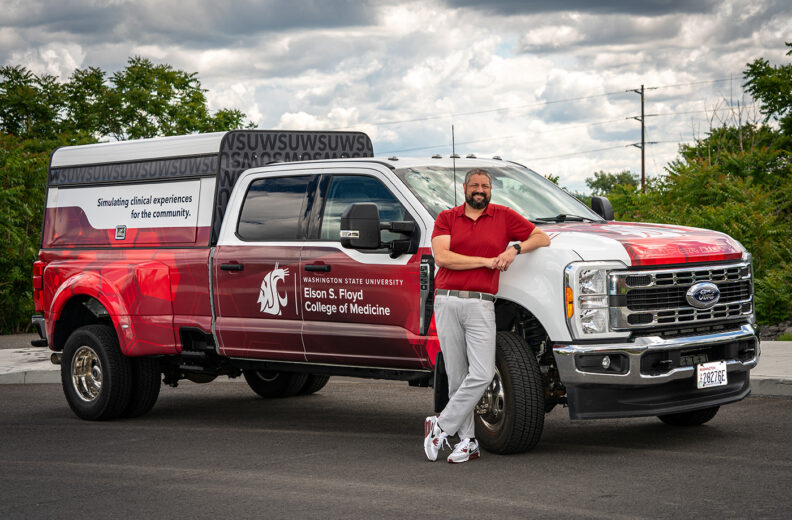
As the College of Medicine’s Virtual Clinical Center continues to evolve to meet the demands of a growing college, we spoke with center leadership Chris Martin, EdD, MHS, CHSE, about his pathway to simulation-based medical education and the future of the field.
Martin was recently appointed assistant dean for simulation-based education after serving as the college’s director of simulation-based training and clinical assistant professor since 2018. The following conversation has been lightly edited for length and clarity.
Can you tell me a bit about your educational and professional background? How did you become interested in simulation-based medical education?
I never intended to be in medicine. I was planning on being a public relations major in college until a coworker who was an emergency medical technician (EMT) got me interested in emergency medical services. I did my EMT certification and worked as an EMT for several years. Then I did a Google search one night, “How do you become a paramedic?” I found Western Carolina University in Cullowhee, North Carolina, which had the nation’s first four-year paramedic degree program, and got my bachelor of science in emergency medical care there.
I spent three of my five years as a paramedic in South Carolina working on my master of health science degree in the front seat of an ambulance at 3:00 a.m. parked at a gas station off Highway 9, which was great. As I was about to complete my master’s program, a job opened at an osteopathic medical school for a director of simulation, which encompassed mannequin-based simulation and procedural skills. My paramedic program was one of the first to use mannequin-based simulation, so that was one of the things that interested me about the job. I was hired and stayed there until I came to work for the WSU College of Medicine in 2018.
Between 2013 and 2018, I also went to the University of Florida to get my doctorate in education in curriculum and instruction, with a concentration in educational technology. It was a great fit because simulation centers are natural innovators, pushing the edge of technology. My mentor at my prior osteopathic medical school actually put my name into the hat for my current position.
What have been some notable achievements of the Virtual Clinical Center during your time there?
One of our first major successes was finishing the VCC building as it is today, which was made possible due to generous gifts from the Paul Lauzier Foundation and Northwest Farm Credit Bureau.
Another major success is what we were able to do during the pandemic. We shifted so quickly to a digital platform. Because the college was so new, we had the ability and the freedom to innovate, with the help of Office of Technology Director Erika Fleck and her team. We were able to jump in and do 32,000 unique patient encounters with our students, which is a volume other schools weren’t able to do as easily during that period.
We’ve also expanded the number of programs we support, beyond undergraduate medical education. In addition to supporting students in all four years of the MD program, we now support the college’s three graduate medical education programs as well as students in the Nutrition and Exercise Physiology and Speech and Hearing Sciences departments. And we’re up to about 100 standardized patients after starting with 10.
One of our more recent successes is the mobile simulation unit, which logged over 13,000 miles in its first year. We can now have a statewide presence, and we’ve been able to offer nationally recognized certification courses to our community partners and faculty. Last summer we launched our first advanced life support in obstetrics and neonatal resuscitation courses, which would otherwise require out of state travel for providers. So being able to provide that resource has been really important and speaks to our mission of serving Washington communities.
What do you find most rewarding about your position?
One of the things that attracted me to the position was that the college didn’t have 100 years of entrenched academic history to go against. We had a blank slate, and we could innovate. Having the opportunity to create something from scratch has been incredible, and the support of everybody with a similar mindset has been a great aspect. It’s not just us innovating—it’s our curriculum team, our assessment team, our faculty. I’m thankful to be supported by such a great team and the other units that we interact with.
Are there any upcoming projects or initiatives you’re particularly excited about?
One of the most exciting things that will happen not only for the College of Medicine but also for WSU Spokane is the development of the Team Health Education building. It’s going to be the simulation space for all three WSU Health Sciences colleges, with areas for the individual colleges to conduct education and to engage in interprofessional activities for the next generation of health care workers.
This will be the fifth simulation center I’ve helped start, but being able to do it from the ground up has been very rewarding. I’m thankful that the rest of the planning team from College of Pharmacy and Pharmaceutical Sciences, College of Nursing, and the campus is all on the same page and looking out for our health sciences students.
How do you stay up to date with the latest advancements in simulation-based education and technology?
The Society for Simulation in Healthcare is a great resource, which I engage with daily. I’m always looking for opportunities to innovate and different ways to work with what we have, focusing on sustainability in low resource environments. Also, medical simulation as we know it today started in the early 1970s with the development of larger academic simulation centers, and now we’re finally talking to each other and developing a shared lexicon. That lexicon has allowed a better sharing of ideas.
How do you see the role of simulation in medical education evolving in the future?
I subscribe to one of the original ideas behind the College of Medicine’s simulation space: as a place to transition between the large lecture format to small group work. You can go talk to a standardized patient, discuss as a group, and then go back to the patient, all in a setting that is indiscernible from an authentic clinical experience.
There’s also an increasing focus on competency-based medical education and the need for patient safety. So, let the students make mistakes in the simulated area, but also engage as if they were practicing physicians so that they can develop those skills in a safe container to learn.