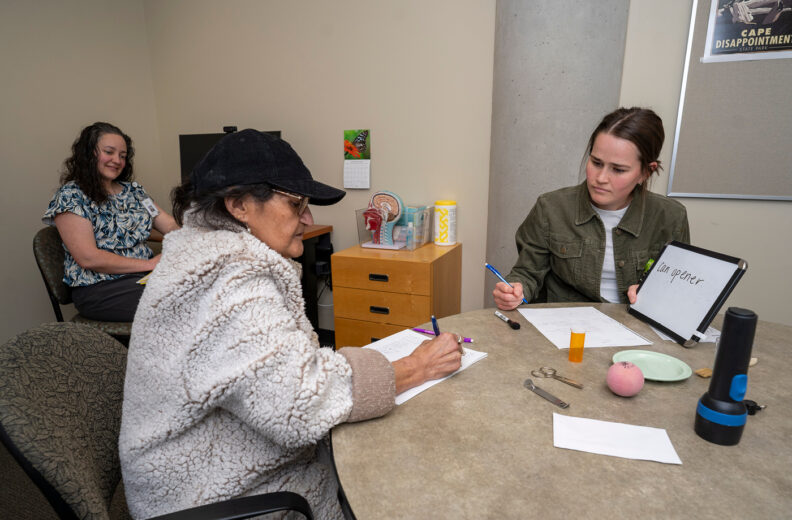
With new clinical faculty joining the team in the past year, the Speech-Language Pathology Services Clinic, operated in affiliation with the WSU Elson S. Floyd College of Medicine’s Department of Speech and Hearing Sciences, is making a big impact for patients in eastern Washington.
The Speech-Language Pathology Services Clinic, located on the WSU Spokane campus and operated through a partnership between the Department of Speech and Hearing Sciences and the WSU-affiliated nonprofit Range Community Clinic, supports a wide range of clients with communication, cognition, and swallowing disorders. The clinic serves clients of all ages, which differs from many other speech-language pathology clinics that treat either children or adults only.
The clinic has grown to a team of six providers since its launch in 2023, all with focused clinical expertise in different areas of speech-language pathology.
Dana Algeo-Nichols, PhD, CCC-SLP, clinical associate professor and director of off-site programs, Emily Schreiner, MA, CCC-SLP, clinical assistant professor and interim director of on-site programs, and Ashley Winkle, MS, CCC-SLP, clinical assistant professor, each bring expertise in pediatric communication disorders.
Jennifer Kurtulus, MS, CCC-SLP, clinical assistant professor, and Aimee Stormo, MA, CCC-SLP, clinical assistant professor, have backgrounds in adult communication, cognition, and swallowing disorders. Jessica Lewis Mowry, MM, MA, CC-SLP, clinical assistant professor, brings experience in pediatric communication disorders, gender-affirming voice therapy, and voice and upper airway disorders to the team.
The large team allows the clinic to provide evaluation and therapeutic services for more than 15 different communication areas like pediatric language disorders and delays, adult speech and voice disorders, swallowing problems, cognitive problems resulting from brain injury, stroke, or neuromuscular disabilities, and so much more. The team also has access to top-of-their-field researchers at WSU.
“We are not only fortunate to have a team of clinical experts, but we also have access to such wonderful research staff who are amazing at collaborating with us,” Kurtulus said. “And because we are a university clinic, we always have different eyes on every case whether it be from a brand-new student or a colleague. I think that helps us maintain a level of elevated practice.”
As an educational training facility, the clinic plays an important role in training the next generation of health care professionals who are earning their degrees at WSU. All providers also teach classes and work one-on-one with students to ensure they are getting the hands-on experience necessary to enter the workforce as speech-language pathologists (SLPs) after graduation. Practicum hours happen in the on-site clinic and in off-site clinics with community partners—both offering important experiences for the students.
“To our community partners, we’re highlighting the benefit of teaching and training the future generations while also staying connected to the university,” said Algeo-Nichols, who coordinates off-site internships.
“A benefit of having the students when you are out in the community is that you are learning the brand-new information that they are learning in class,” Schreiner added. “Maybe it’s been a while since you’ve been in school, so to have those conversations with these students who are learning the fresh, new information is really beneficial.”
In both the off-site and on-site placements, students gain the real-world experience of a fully functioning clinic atmosphere. However, the Speech-Language Pathology Services Clinic provides an added opportunity for students to collaborate with each other, faculty, and researchers.
The collaboration also benefits the patient. The clinic typically schedules clients for 50 minutes twice a week, which is longer than the standard 30-minute sessions offered at many other clinics. Plus, the clinicians and students spend an estimated 40 minutes planning for each appointment.
The clinic has observation rooms open to family members and caregivers to watch the licensed clinical supervisors and learners work directly with the client. In addition, the providers take the time to answer questions before and after appointments.
While clients are occasionally worried about receiving care from a student trainee, the providers point out there is a benefit to working with supervised students.
“The students are highly motivated, engaged in research, asking lots of questions, and having conversations to really figure out what’s going to be best for the client,” Stormo said. “Seeing the students and clinical educators working together reflects a level of care, attention, and focus you don’t often get in other settings.”
“I always try to impress on the clients that we are so thankful for them,” Winkle added. “It is such an amazing learning opportunity for our students, and we want them to feel special for being a part of that.”