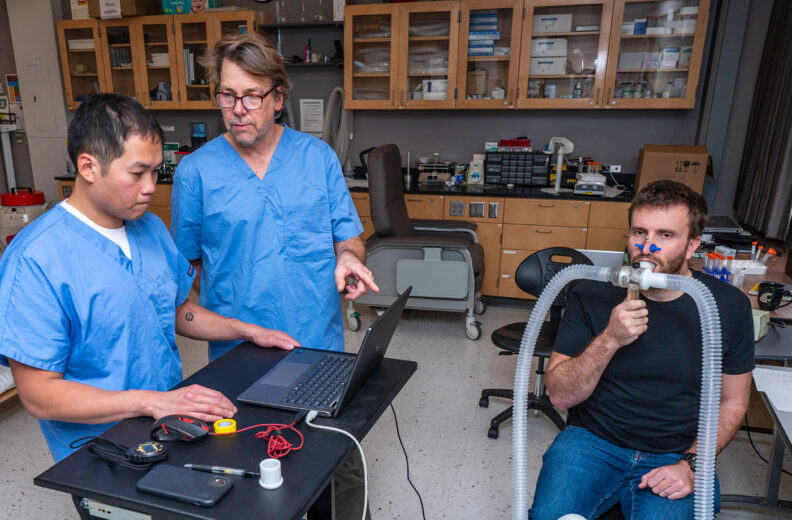
New research from the Department of Nutrition and Exercise Physiology aims to determine whether the standard method of interpreting a common lung function test in older adults is flawed, potentially leading to misdiagnoses and inaccurate assessments of lung health.
Associate Professor Hans Haverkamp, PhD, and doctoral student Peter Luu were awarded a $275,000 grant from the National Institutes of Health (NIH) to investigate mechanisms of lung function decline in older adults and determine whether changes to the lungs from normal aging processes skew the results of pulmonary function tests, also called spirometry. The project is funded by the NIH’s National Institute on Aging through an R21 grant, which is designed to support novel scientific ideas and methods.
The current approach to interpreting one of the most common spirometry measures, forced vital capacity (FVC), doesn’t account for structural changes to the airways and lungs that occur during the normal aging process. Lung tissue becomes less elastic over time, for instance, resulting in narrower airways.
“This project challenges the common assumptions made by clinicians worldwide when evaluating lung function in the elderly,” said Luu, a fourth-year PhD student who has collaborated with Haverkamp on research since he was an undergraduate NEP student. “We hope our results will allow practitioners to better understand the effects of aging on the lungs and to develop better strategies in disease prevention and treatment.”
Commonly used to diagnose respiratory illnesses like asthma and chronic obstructive pulmonary disease (COPD), FVC measures how much air a person can forcibly exhale after a deep breath. This study will be the first to comprehensively investigate whether physiological responses to deep inhalation vary by age.
In young and middle-aged adults, taking a deep breath causes the airways to widen more than during normal breathing, enabling more airflow. In older adults, however, the researchers predict that deep inhalation won’t cause as much airway widening on account of structural changes to the lungs, decreasing older adults’ maximal expiratory airflow (MEF) during FVC testing.
In clinical practice, interpretation of FVC results assumes all age groups experience the same airway dilation during the deep inhalation maneuver. If older adults don’t experience as much widening, clinicians could be misinterpreting their MEF scores and assuming reductions are from disease, not normal aging.
“We have to know how respiratory system function changes in a healthy person in order to distinguish between disease and normal aging-related declines,” Haverkamp said. “If the results support our hypothesis, that means the medical community overestimates the degree of decline in lung function with aging.” This could lead to inaccurate diagnoses and mismanagement of common lung conditions.
To identify aging-related differences in deep inhalation response, the researchers plan to compare spirometry results in adults aged 18-45 and 65 and older. They also plan to compare how both groups respond to medication that constricts the airways. Participants will complete a methacholine challenge, inhaling a medication that causes mild airway narrowing.
In addition to standard spirometry tests, the researchers will use an esophageal balloon-tipped catheter to measure pressure surrounding the lungs. The minimally invasive device consists of a thin plastic tube with a small inflatable ballon on the end that is inserted through the nose and into the esophagus until positioned behind the heart. There, a small amount of air is injected into the balloon in order to measure lung distending pressure during various breathing maneuvers.
Results of the two-year study will help inform clinical interpretations of spirometry and decisions concerning the diagnosis and treatment of lung diseases in older adults.
The research team also includes Sterling McPherson, PhD, a WSU College of Medicine professor and interim vice dean for research; Thomas DeCato, MD, a College of Medicine assistant professor; Victoria Settler, PhD, a registered nurse and former WSU College of Nursing employee; and Tony Babb, PhD, FACSM, professor of internal medicine and pulmonary and critical care medicine at the University of Texas Southwestern Medical Center.
Interested in Participating in the Study?
The researchers are seeking both young adults and older adults to participate in the study. All participants must be between the ages of 18–45 years or 65 years or older and in good health. The study will require two visits. All research visits will take place in the Exercise Physiology Research Lab on the WSU Spokane campus.
To learn more, please contact Hans Haverkamp at hans.haverkamp@wsu.edu or call 509-368-6912. This study has been approved for human subject participation by the Washington State University Institutional Review Board.
This story was originally published in NutrEx, the Department of Nutrition and Exercise Physiology newsletter. Read the latest edition.