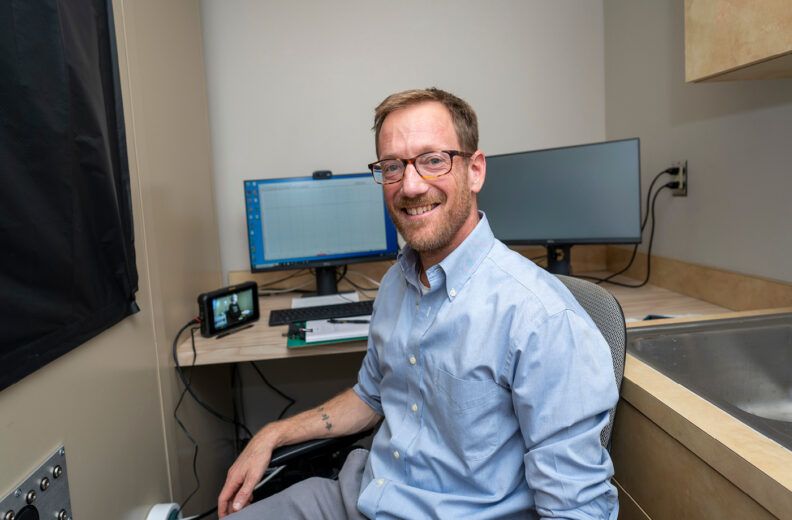
The road David Jenson, PhD, took to the Elson S. Floyd College of Medicine’s Department of Speech and Hearing Sciences (SHS) hasn’t always been straight—and that’s what informs his leadership today.
Jenson has served as interim chair since July 2025, but he didn’t set out to take an administrative role at the college. He didn’t even set out to work in the field of speech-language pathology. Instead, his journey began in a much different setting: working in Egypt as a scuba instructor.
“I tell students that I took a gap decade,” Jenson said of his earlier days.
Jenson’s interest in language stemmed from his experiences living and working in Egypt.
“I wanted to learn the local language, so I made a conscious decision to live in a part of Cairo where I would encounter minimal English and would have to rely on Arabic,” Jenson said. “It was eye-opening and humbling to be able to communicate clearly and get my needs met one day, then be unable to communicate effectively the next. I have a vivid memory of trying to order some food, repeating myself over and over, and still not being able to make myself understood. Someone finally had to step in and order for me.”
When he moved back to the U.S., that experience was in the forefront of his mind.
“I didn’t want to take being able to communicate for granted,” Jenson said.
Jenson’s burgeoning interests brought him to graduate school, where he intended to pursue a career in rehabilitation for those experiencing post-stroke communication challenges. His academic work brought him closer to lab science, where he discovered both the field of stuttering and lab research at the same time.
“The more you expose yourself to something, the more interesting it becomes and the more questions you have,” Jenson said. “Down the road after I specialized, I would have several family members who stutter. Who knew I would have family connections to my own field?”
Jenson’s pursuits brought him WSU, where his research now spans sensorimotor integration, speech motor processing, and perceptions of stuttered speech through his Speech Fluency and Electrophysiology Lab. He also spends time teaching stuttering and neuroanatomy to SHS students.
“I rework the course on stuttering every year because the field is changing so quickly,” Jenson said. “What stuttering looks like from the outside doesn’t match the inside-out experience of people who stutter. It’s a very misunderstood condition.”
As an educator and now as interim chair, Jenson espouses the belief that the goal is not to train students in a rote course of action. Rather, it is to teach people to be evidence-based clinicians.
“Hopefully you aren’t doing something ten years from now just because that’s what you were taught today,” Jenson said. “Science should be constantly evolving. This frames the way we’re training our students, teaching them to engage in evidence-based practice with the best evidence available.”
This model also centers his strategic vision for the department, which focuses on expanding community engagement and increasing faculty and student research opportunities and clinical work. The newly launched WSU Health Speech-Language Pathology Clinic in Spokane offers new opportunities to deepen these local connections and extend the department’s impact through science and training.
To Jenson, it’s all about creating—and sustaining—community.
“We don’t want Wazzu to be something that you only see in the rearview mirror,” he says.
He invites alumni to stay connected, engage with the department as a resource, and see themselves as part of a vibrant network.
“You’re part of a community of clinicians shaped at WSU.”