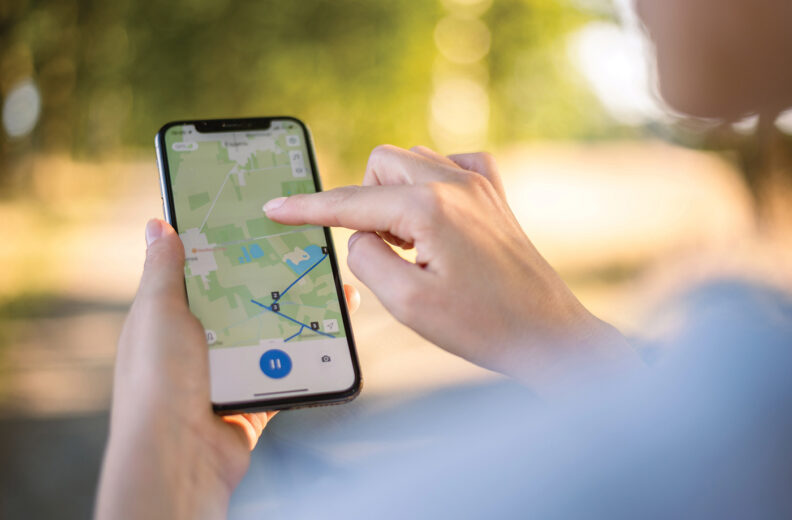
SPOKANE, Wash.—A powerful tool for public health research could be in your pocket.
Researchers at Washington State University have pioneered an innovative method for using Google Location History (GLH) data to conduct large-scale longitudinal studies on human behavior and health on topics ranging from outdoor exercise habits and visits to fast food outlets to exposure to environmental pollution.
A “citizen science” approach where smartphone users share their phone data with researchers provides an efficient and cost-effective way to collect years of data about exercise habits and other behaviors compared to older methods such as having study participants wear a GPS tracker for several weeks.
Google Location History (GLH) data, an opt-in form of precise location tracking available through Google Maps, is one form of user-generated data that could have broad applications for public health research and policymaking.
“This data is like nothing else out there because it covers a long period of time in a very granular way,” said Ofer Amram, PhD, associate professor in the WSU Elson S. Floyd College of Medicine’s Department of Nutrition and Exercise Physiology (NEP) and one of the lead authors on the research. “It can give us insight into how human behavior interacts with the environment, and when we link it with health data, we can look at how behavior and environment impact health outcomes.”
In a series of studies, collaborators from NEP and WSU’s School of Electrical Engineering and Computer Science tested the data’s usefulness by recruiting 270 members of Washington State Twins Registry who had participated in previous exercise research and were willing to share their GLH data. Participants collectively shared nearly 18 million months of data, with some records spanning over a decade.
The researchers then compared how Google’s proprietary algorithm classified movement into activities such as walking, biking, and driving with GPS and accelerometer data previously collected on a subset of participants. The resulting analysis, published in the Journal of Physical Activity and Health, found the algorithm accurately classified walking but was not as reliable for running or biking.
The researchers also connected the location data with health data collected in previous twin studies and found a strong association between amount of walking and having a healthy weight, confirming that GLH data produces the same results as other research methods.
A Versatile Tool for Public Health and Computer Science Research
The potential applications of GLH data are broad. In a second analysis published in the International Journal of Health Geographics and led by WSU Computer Science PhD student Olufunso Oje, MA, the researchers found GLH data is detailed enough to study how often people visit fast food outlets compared to other restaurants and grocery stores. This could allow researchers to study how an individual’s “food environment,” including the physical availability of different types of food, impacts food choices and health outcomes.
“Imagine the difficulty of asking someone to recall where they ate a few years ago. Yet with this data, we can trace detailed food environment exposures over time that would otherwise be impossible to study,” Oje said.
The detailed data gives researchers a more comprehensive picture of where people get their food, whether at conventional retail locations like the supermarket or other locations like convenience stores.
“The GLH data allows us to go beyond just looking at retail availability and instead look at where and when people actually access food, which could impact their food choices and health outcomes,” said NEP Professor Pablo Monsivais, PhD, MPH, principal investigator on the food study.
GLH data can also be linked to other types of data to provide a more complete picture of population health, such as data on exposure to environmental pollution, a third analysis published in Environmental Health Perspectives found. While most studies use participants’ home addresses to estimate their exposure, GLH data enables researchers to estimate exposure wherever participants take their phones, providing more accurate assessments.
Additionally, the challenges of working with such enormous quantities of data sparked innovations in computer science.
“Working with GLH data at scale across a range of applications has enabled us to make advancements in foundational data mining algorithms that overcome challenges posed by the sheer volume of location records collected over time,” said Assefaw Gebremedhin, PhD, Oje’s advisor and an associate professor in the WSU School of Electrical Engineering and Computer Science.
To address this, the researchers developed a general framework for efficiently managing and processing large-scale GLH datasets. Published in ACM Transactions on Spatial Algorithms and Systems, the framework provides a scalable method for handling vast amounts of location data while preserving the granularity needed for public health research.
The researchers note that GLH data may raise privacy concerns regarding location tracking. GLH is an opt-in feature for Android and other smartphone devices with Google apps, and by default the data is stored on the user’s device, not the cloud. Researchers can also manage privacy concerns by anonymizing large datasets.
With personal health and fitness devices increasing in popularity, the outlook for new applications in health research is bright. Not only can user-generated data transform population-level health studies, but it could also result in personalized health reports for users that provide insights beyond reports generated by their devices, such as a personalized report of pollution exposure. With new analysis methods, the smartphone in your pocket could provide life-saving insights into health and well-being.
This research was supported by funding from the National Institutes of Health, the National Institute of Environmental Health Sciences, and the National Institute of Aging.
Media Contact
Stephanie Engle, WSU Elson S. Floyd College of Medicine Communications and Marketing, 509-368-6937, stephanie.engle@wsu.edu